Sauna electrical coordination explained
What electrical coordination means on a sauna project. Who does what, when it happens in the sequence, and why we give no electrical guidance on this site or on the phone.
5.0 on Google across 80+ verified reviews
Electrical is the part of a sauna project people worry about most, and the internet has not helped. Search the question and you will find charts, rules of thumb, and confident numbers offered by people who have never seen your house.
This article explains what the electrical side of a project looks like from our side: who does what, when it happens, and where our answer stops.
The short version
Electrical coordination is part of every project we build. We coordinate. Licensed trades perform. What your room needs is assessed on your property, and our team will assess this with you during the consultation.
That is the whole arrangement, and every section below is an elaboration of it.
Why there is no chart on this page
A figure that is right for one house is wrong for the one next door. What a sauna asks for depends on the room, the heater, and the building it is attached to, and none of those are knowable from a web page.
Publishing a figure would be easy and it would be irresponsible. Someone would carry it into a decision it does not belong in. We give no electrical guidance on this site and none on the phone, because that is licensed work and it belongs to the person who holds the license.
What we coordinate
Coordination is real work, and it is the part that goes missing when a sauna arrives as a box.
- We settle what the room will be before the electrical conversation starts, because the room drives everything downstream.
- We bring the licensed trade into the project early rather than after a pad is poured and a sauna is standing on it.
- We sequence the work so nothing waits on anything else.
- We stay in the middle of the conversation between the trade, the site, and the equipment, so you are not translating between them.
- We are accountable for the project as a whole after everyone has driven away.
What we ask about during a site assessment
The questions are about the project, and they are the same every time.
- Where the room is going. Indoors, outdoors, attached, detached.
- Which sauna, and which heater. Traditional or infrared, and the model.
- How the room will be operated. At the door, on a schedule, or remotely.
- Who else is working on the property, and whether the work can be sequenced alongside them.
Everything electrical that follows from those answers is assessed on your property by the licensed trade, and your specialist walks you through it during the consultation.
Traditional and infrared are different rooms
A traditional sauna heats a room and the stones in it. It reaches approximately 170°F in about an hour. An infrared room warms the body directly rather than the air around it, and reaches approximately 130°F and above.
Which one suits you depends on the space, the household, and how you want the heat to feel. Clearlight is our standing indoor recommendation for infrared. Where the household wants traditional heat and steam, the heater is matched to the room during the consultation. What either room needs electrically is assessed on your property, never from a page.
Controls and remote operation
How a room is operated comes up during the assessment, because it is part of what gets coordinated.
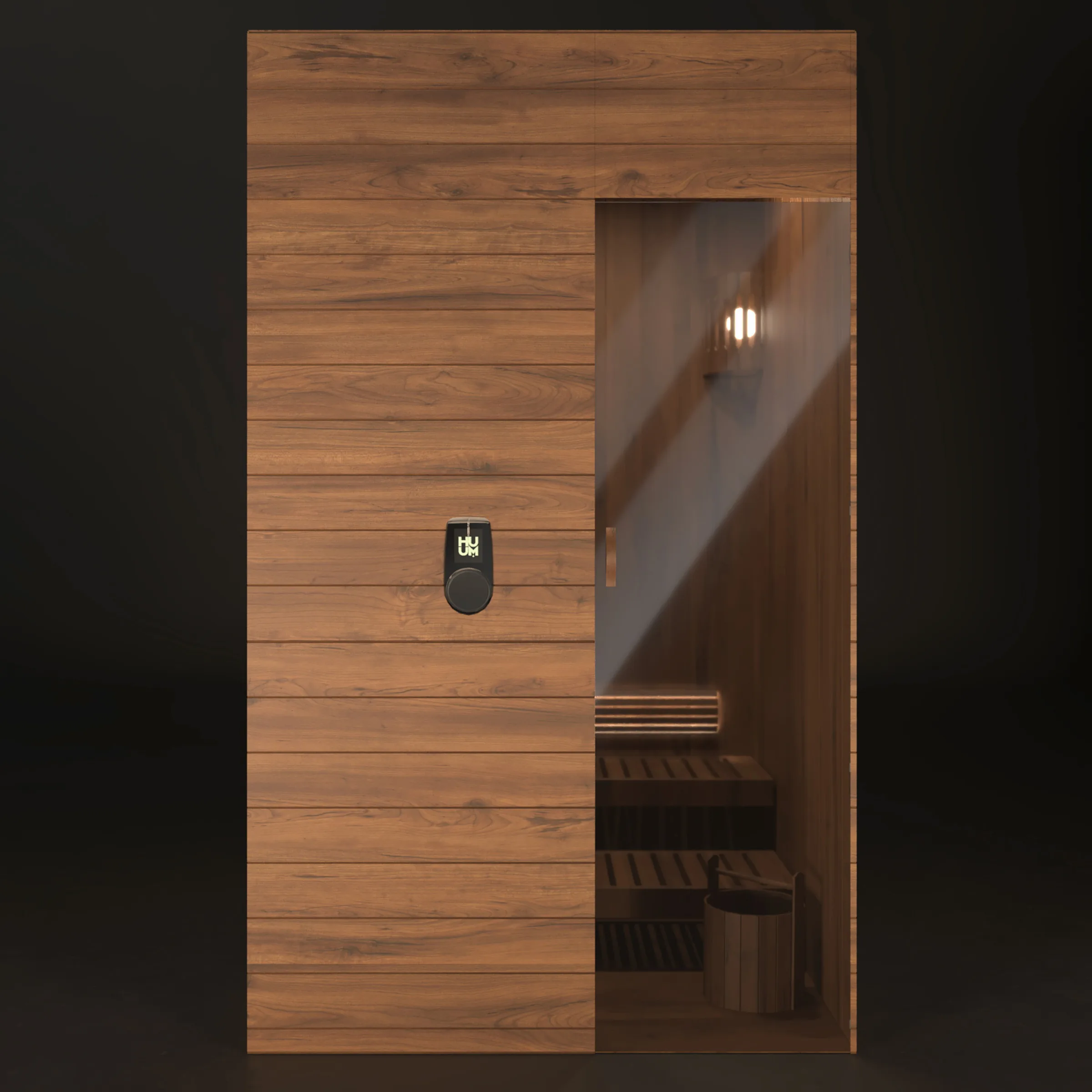
Harvia Xenio and Wi-Fi control are the convenience upgrade, and they matter most where the room is operated remotely. That is close to essential for a short-term rental, where the room needs to be warm before a guest walks out to it and off when nobody is in the property. It is also a real convenience at home, where the walk out to turn a sauna on is often what decides how much it gets used.
The point for this article is narrow: decide how you want to operate the room early, so it is part of the plan from the start.
Where our answer stops
We will tell you what the process looks like, what we will ask, and where the electrical work sits in the sequence. We will bring a licensed trade into your project and coordinate their work alongside the pad, the delivery, and the assembly.
We will not tell you what your sauna needs electrically or what your jurisdiction requires. Those answers belong to a licensed professional on your property.
What to expect, in order
- Consultation. The room, the site, the household, and the intended use.
- Site assessment. The spot, the route, the pad, and the questions above.
- Electrical coordination. The licensed trade assesses the property and the work is sequenced against site preparation and the delivery date.
- Delivery and assembly. Most assemblies take four to eight hours on site.
- Commissioning and the first-burn walkthrough.
- Support afterward, from people who were there when it went in.
That sequence is the same in Colorado, in Southern California, and across the Kansas City metro. What changes is who the local trades are.
If you are earlier in the process, what determines the cost of a home sauna covers how electrical coordination sits alongside everything else. When you are ready, call 720.780.4400 for a free estimate, or have us walk your space.
David Drimmel, founder
Sauna Friend Sanctuary Supply is family owned and operated, and an integrated auxiliary of Bioharmony Collective, a mission-driven ministry. More about how we came to work this way.