What coastal salt air means for sauna hardware and heater surrounds
Why airborne salt corrodes a coastal sauna's hinges, screws, and heater surround before it touches the wood, and what that means for hardware grade when choosing a sauna near the Southern California coast.
5.0 on Google across 80+ verified reviews
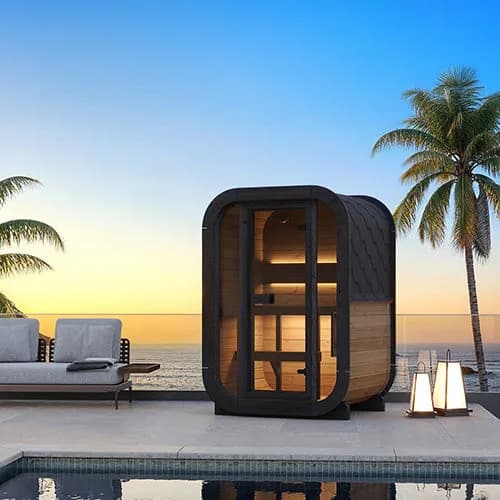
Salt-laden coastal air corrodes exposed metal, hinges, screws, brackets, and heater surrounds, faster than it affects the wood around it. Near the Southern California coast that makes hardware grade a genuine factor in choosing a sauna, not an afterthought decided once wood and format are settled. Heater surrounds tend to show it first.
That order surprises people, because most sauna guidance leads with wood species and climate. On a coastal property the more urgent conversation is what the air is carrying, and what it does to metal long before a cedar or thermally modified wall shows anything at all.
Where the salt in the air comes from
The mechanism is straightforward. Waves and surf break seawater into fine airborne particles, and onshore wind carries them past the sand and into yards that never get wet. Those particles settle on any exposed surface, and once humidity is added, the two together create the conditions that accelerate corrosion. It is the same process that eats at air conditioning condensers from Santa Monica and Manhattan Beach down to Redondo Beach and Palos Verdes: salt settles on the metal, and humidity does the rest. A sauna's exterior hardware sits in the same air an AC condenser does, with no cabinet or coil casing to slow the exposure down.
Southern California properties within reach of the water, from Malibu and Santa Monica through Newport Beach and Laguna Beach to Del Mar, La Jolla, Encinitas, and Carlsbad, sit inside that exposure, and it reaches farther inland than most people assume.
Hinges, screws, and brackets take it first
On a coastal job the hardware goes first. Hinges, handles, screws, brackets, and heater surrounds are usually the first parts to show rust or staining, so we look at them first when a member near the water is choosing a model.
Every item on that list is metal, and none of it is finished the way the wood around it is. A cedar or thermally modified wall gets a protective treatment suited to the climate. A door hinge, a mounting screw, or a bracket generally does not, because it has to keep moving, keep its thread, or keep its shape under load. That leaves bare or lightly coated metal facing the same salt-laden air as the wood, without the wood's layer of protection.
Why heater surrounds show it soonest
A heater surround is the guard or enclosure built around the heater, and depending on the model it can be a full metal housing, a metal frame, or just the brackets and trim that hold it to the wall. Whichever form it takes, it is usually the largest run of exposed, unfinished metal in the room, so it has more surface for salt to settle on and more surface where staining shows up early.
It also cannot be finished the way wood or trim can. A heater surround is selected for how it performs around sustained heat, not for how it resists a coastal atmosphere, so the two do not automatically line up on their own. That is why we treat heater and surround selection as part of the site conversation on a coastal build, alongside the wood and the format, rather than a fixture decided after everything else.
Salt goes after fasteners, hardware, and finishes well before it goes after wood. A coastal build has to answer for that order, not just for the wood.
What this means when you are choosing a sauna
For a Front Range or Kansas City project, hardware grade is a minor line item. For a coastal Southern California property, it belongs in the same conversation as wood species, format, and heater selection, because it is one of the first things a member will watch age.
Ask any specialist what hardware is used, what maintenance it needs, and whether exposed parts need rinsing or treatment in a high-salt location. Those are fair questions alongside placement itself, since distance from the water and shelter from nearby structures change how hard the air works on a given wall.
- What hardware is specified for hinges, screws, and brackets on an exterior build.
- What the heater surround and guard are made of, and how that holds up near salt air.
- What rinsing or inspection rhythm the site's specific exposure calls for.
None of this makes a coastal sauna a maintenance burden, and none of it is unique to saunas. The same logic applies to any exterior hardware near the coast, from a deck railing to an AC condenser. The routine is simple: rinse salt build-up from exposed metal when it accumulates, keep an eye on seals and fixings, and address staining while it is still surface level. We do not publish a single interval, because the honest one depends on how close a site sits to the water and how sheltered its hardware is, which is what a site assessment is for.
Frequently asked questions
Does salt air affect an indoor sauna's hardware the same way it affects an outdoor one?
Not to the same degree. An indoor or infrared sauna sits inside the building envelope, so its hardware is shielded much the way the rest of the house's interior fixtures are. This exposure is mainly a concern for an outdoor sauna's exterior hardware and heater surround.
Is this the same issue as the marine layer humidity Southern California gets in late spring?
Related, but a different mechanism. Marine layer humidity keeps a sauna's wood from fully drying out for weeks at a time, covered in caring for an outdoor sauna through the marine layer season. Salt air works on metal specifically, and it is worth planning for separately.
Can better hardware eliminate the corrosion risk entirely near the coast?
No. Suitable hardware slows the process and is worth choosing, but no exterior metal at the coast is maintenance free. A rinsing and inspection rhythm still matters, set to your site's actual exposure rather than a generic schedule.
How close to the water does this matter?
Closer than most people assume, and it is not limited to properties on the sand. Salt-laden air reaches inland past the immediate waterfront, which is why we raise hardware and heater surround material early in a coastal consultation rather than waiting for a member to notice staining.
Send photographs of where the sauna will sit and how exposed it is to the coast, and we will tell you plainly what the hardware and heater surround should be built from. Request member pricing, or call 720.780.4400 and start with the site.
David Drimmel, founder
Sauna Friend Sanctuary Supply is family owned and operated, and an integrated auxiliary of Bioharmony Collective, a mission-driven ministry. More about how we came to work this way.